
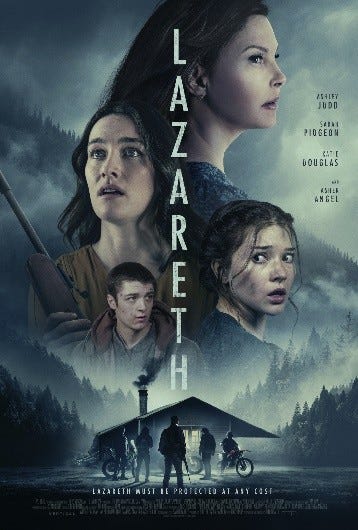
With so many movies being released each week, it’s often hard to watch and review every single one of them. Because of that, I wasn’t at all surprised when I learned I had missed the post-apocalypse thriller Lazareth, starring Ashley Judd, when it was released a few years back. Mind you, movies involving viruses are nothing new, and they’ve become more prevalent and relevant sinec the world was hit by an actual pandemic.
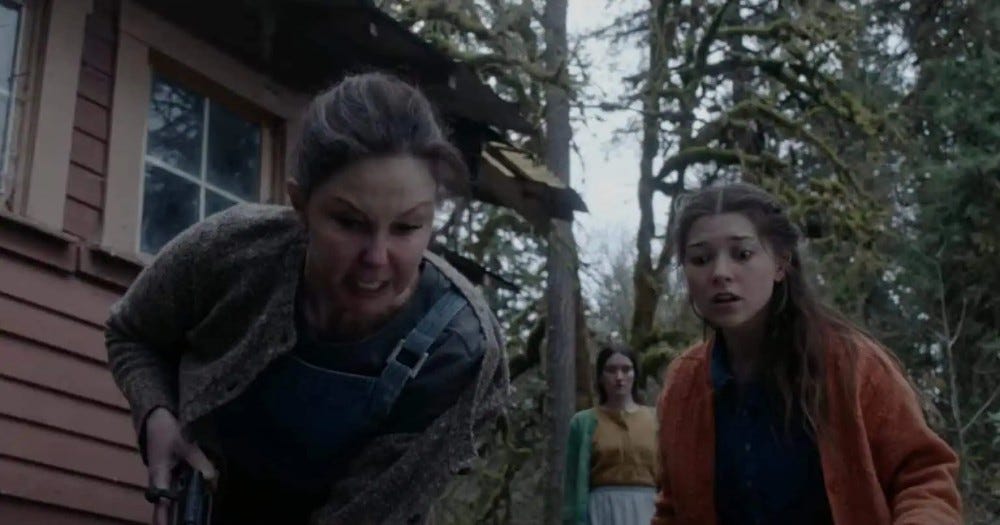
The oddy-titled Lazareth – a first-time feature written and directed by Alec Tibaldi – takes the simplest approach to this sci-fi sub-genre, focusing on three women living in a house in the middle of the woods after a virus has devastated life on earth. They dub this home “Lazareth,” and Judd plays Lee, the matriarch of the household, taking care of two girls, who I thought were her daughters but may actually be her orphaned nieces, Maeve and Imogen, played by Sarah Pidgeon (Love Story) and Katie Douglas (Ginny and Georgia). Their quiet lifestyle faces change when Imogen spots a young, badly wounded man named Owen (Asher Angel from Shazam!) living in a tent near their home, and brings him to Lazareth to help him. This act makes the family a target for a rough gang of savages, of which Owen once was a member.
At first, Lazareth does not come across as something particularly original or unique, because having a parent being overprotective of their children during a global crisis is something we’ve seen so many times, and as recently as the Halle Berry film Never Let Go, directed by Alexandre Aja, which was far more horror and genre than Lazareth, which is more of a family drama.
Within the opening moments of the film, Tibaldi does a decent job setting up a similar world devoid of people ala 28 Days Later, but the focus is almost entirely on Lazareth and Lee’s obsession with defending her girls from the infected. This is very much a movie about women trying to survive this brutal world, and I honestly felt the younger actresses gave stronger performances than Judd, whose character doesn’t offer much room for any range. The young Imogen’s playful curiosity acts as a distinct counterpart to her older sister Maeve’s caution, the scenes with the two girls and Asher offering the film’s strongest dramatic moments, even if the dialogue isn’t always great.
The tension in the film comes almost entirely from the fact that there is this roving band of deadly ravagers who show up at their home, clearly looking for Owen, forcing Lee to drive into town, something she deems too dangerous for the girls, to confront them.
One of Lazareth’s highlights is the burgeoning young love story between Imogen and Owen, which brings a lot to the mix while the overall story is going to many expected places. The film’s overall setting of a stark and barren woods makes the film quite visually appealing, accompanied by a gorgeous orchestral score by Amadeo Ursini, who has surprisingly few credits on his IMDB page. One can easily that Lazareth could be a terrific calling card for this composer to get more work.
Alec Tibaldi’s Lazareth isn’t particularly groundbreaking in terms of its premise, but it keeps the viewer invested in where the story might go, its younger actors offering performances that hold the whole thing together.
Rating: 6.5/10
Lazareth is now streaming on Netflix.