HAMNET REVIEW
“It clearly has something to say, not just about Shakespeare, but about grief and being human unlike anything we’ve seen before”

I’ve been a pretty big fan of Chloé Zhao since first meeting her at the Gotham Awards, where her first movie Songs My Brothers Taught Me received a special grant. Years later, she made the brilliant indie, The Rider, and not long after that, she was winning Oscars for her Nomadland. After an odd tangent into the Marvel Universe with The Eternals (and the less said about that the better), she’s back in the world of prestige filmmaking with a film based on Maggie O’Farrell’s acclaimed novel, Hamnet, which I’ve never read. I’ll freely admit to putting off reviewing Hamnet for a couple of weeks, since I really wanted it to sink in but also I felt it deserved a rewatch, since finding the right words eluded me after just one viewing. It’s not that I immediately loved or loathed it, but I really was on the fence about it for reasons I’ll try to explain.
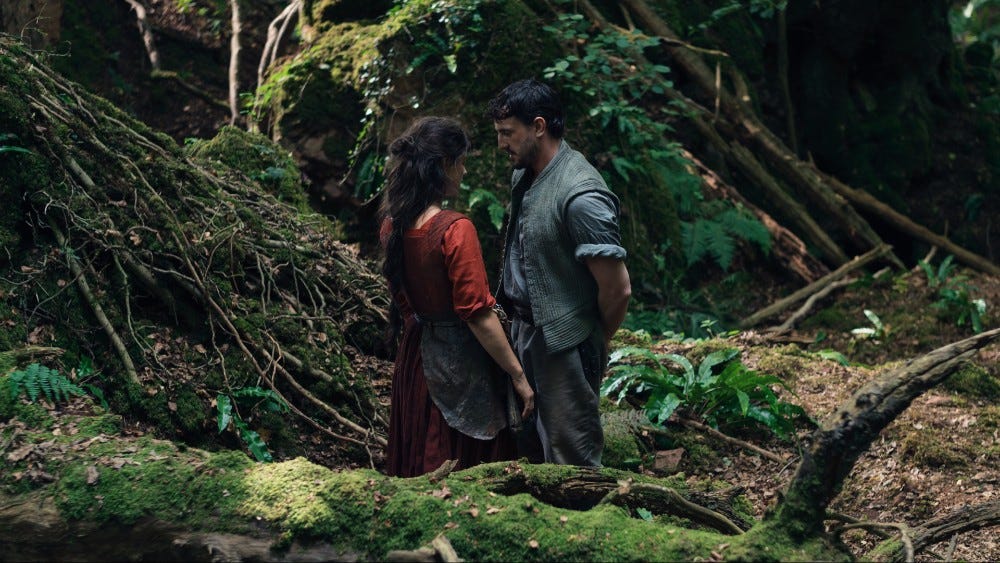
The film begins with the introduction of Jessie Buckley’s Agnes, an enigmatic witchy, young woman frolicking with nature and her pet falcon before she soon encounters the town’s new Latin tutor (I guess that was a thing back then) played by Paul Mescal. A passionate romance begins as the two cavort in the woods and are quickly betrothed, without support from their respective guardians. Agnes (her name strangely pronounced as if there isn’t a “g” in there) is quickly giving birth to their first child, out in the woods, of course, but by then, Mescal’s character (who isn’t actually named for 90 minutes) is constantly leaving Stratford to go down to London to make his mark as a playwright. Wait, have you read this far and not figured out that he’s playing William Shakespeare?
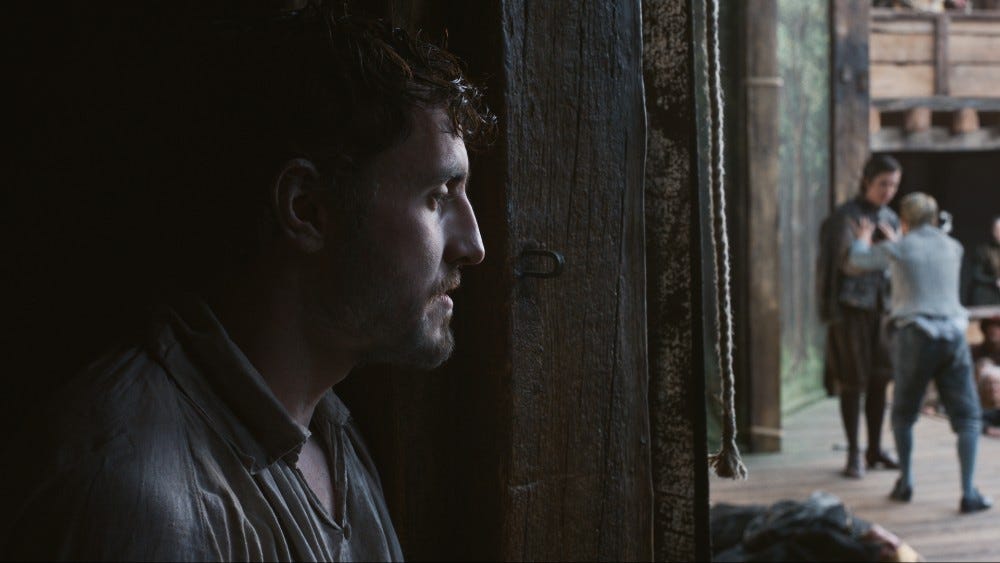
I’ve never been a huge Shakespeare fan. Sure, I’ve read many of his plays, seen some of them performed, and even saw a few movie adaptations that were just fine, but there’s always going to be something that feels pretentious to me whenever a filmmaker, particularly one that also acts, decides to adapt the Bard. That’s even true with Joel Coen’s recent The Tragedy of Macbeth, which still puzzles me, since he’s such an original storyteller and filmmaker, so why go back to that well, especially when Akira Kurosawa made a much better version with Throne of Blood?
Obviously, the people most interested in Hamnet will be Shakespeare fans, although it’s deliberately not meant to be a movie about Shakespeare, even if it is filled with Shakespearean language. It’s a movie about his beleaguered wife and what she goes through over the years leading up to her husband’s fame as a playwright. I’m not sure how much of Hamnet is meant to be historically accurate or how faithful it is to a book I haven’t read. There’s also been so much debate and dissent surrounding Shakespeare, and it’s hard to tell how much research O’Farrell and Chao did into Shakespeare’s life or the times or whether there was any concern about being accurate. A few years ago, Kenneth Branagh directed and starred as Shakespeare in a movie called All is True, which deliberately straddled fact and fiction, and at times, Hamnet seems to do the same.
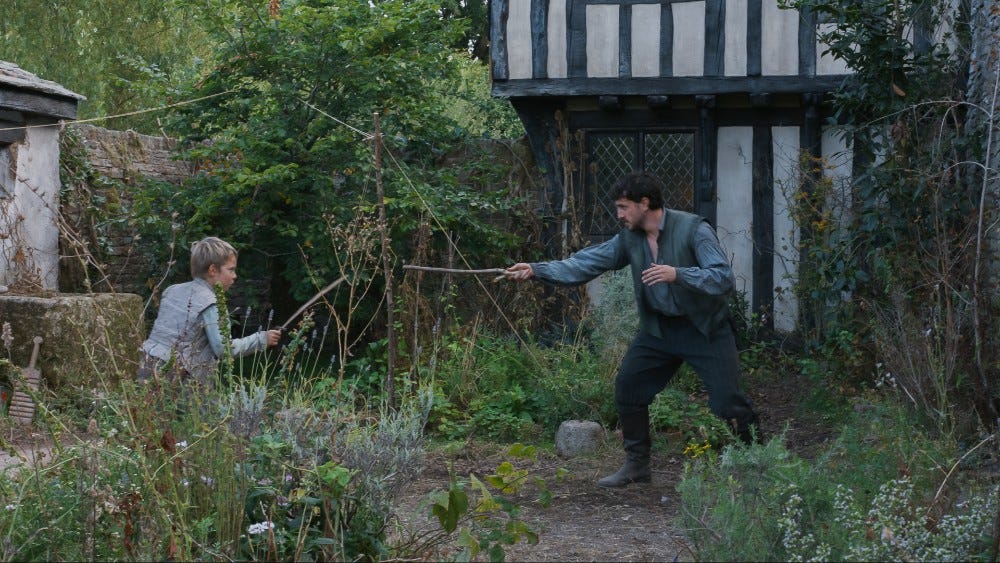
At a certain point, it’s hard not to venture into spoiler territory, since there are aspects of Hamnet, even important plot points, that must be addressed. Agnes experiences so much grief and death, and “Bill” leaving her to travel down to London creates even more strife, as she goes into a laborious childbirth while he’s away. Years later, we watch her kids playfully performing for their parents. Not long after that, we’re watching one of them die, which is likely to throw the viewer for a loop. I personally wondered what happened to that beautiful falcon, and why it was introduced then forgotten, but Mescal’s Shakespeare similarly disappears for a large portion of the film to focus on Agnes.
In fact, the film’s passage of time is often hard to parse, basing it solely on the age of their children and the actors portraying them. Agnes herself goes through quite a transformation, but it’s grueling to spend much of this film watching her screaming, crying, moaning or just carrying on, joining this year’s most frustrating ongoing theme of mothers who are slowly going insane.
Considering the great performances Chao was able to produce from non-actors in The Rider and those cast around Frances McDormand in Nomadland, it’s safe to assume working with trained Oscar-nominated actors like Buckley and Mescal would result in even stronger performances. As much as both actors have proven their mettle time and time again as two of the best actors from the past 10 to 15 years, Buckley’s performance is deliberately showy, and not always in a good way. Agnes’ evolution is often tough to watch, especially whenever Mescal returns and tries to match her intensity in scenes that could be seen by some as outright scenery chewing. Watson reunites with Mescal a few years after the underseen God’s Creatures, playing Will’s mother, who is there for Agnes as she gives birth to her second child, but it’s not much of a role comparatively.
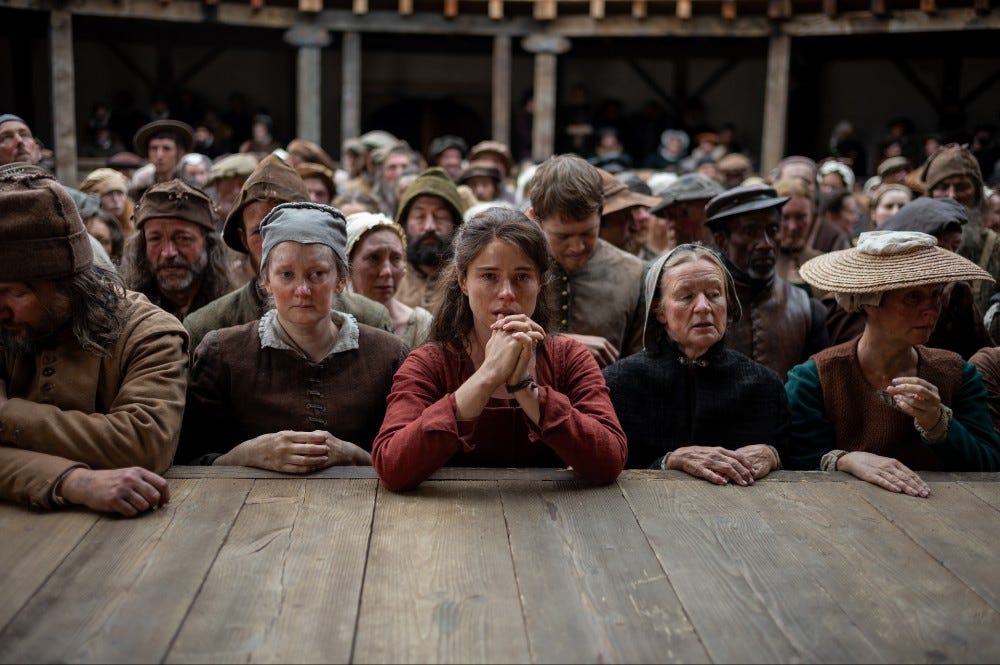
The film’s last half hour is essentially an early performance of Shakespeare’s “Hamlet” at the Globe Theater, as Agnes experiences it for the first time. Shakespeare himself plays a ghost in his own play with actor Noah Jupe playing the title role, a clever bit of casting, since his younger brother Jacobi Jupe plays Agnes and Will’s son Hamnet earlier in the film. The similarities are intentional. At first, Agnes is stunned by the scope of her husband’s production, while acting like the worst Broadway patron possible by talking and shouting during the performance. Soon, she’s absorbed into the story she’s observing and its connections to her own life, leading to a stunning finale.
I’d be remiss if I didn’t at least touch upon the crafts, since Max Richter’s score is phenomenal, making every scene even more emotional. Lukasz Zal’s cinematography ably captures the film’s nature-filled setting and period locations and costumes, making them as important to Hamnet as the writing and acting.
As impressive as the performances are, Hamnet is often a grim and grueling ordeal to watch for what it puts its characters (and the viewer) through. Thankfully, Zhao manages to stick the landing with how things come together by the end. What the actors bring to every aspect of the movie is undeniable. I’ve said this before, but this time I really mean it when I say that Hamnet won’t be for everyone. And yet, it’s a movie that’s impossible to fully write off, as I might have if I wrote this review after a single viewing. It clearly has something to say, not just about Shakespeare, but about grief and being human unlike anything we’ve seen before.
Rating: 6.5/10
Hamnet is now playing in select cities and will continue to expand over the next few weeks.
Can you name a piece of music in cinema more over-used than Max Richter's On the Nature of Daylight? It was a terrible disservice to Hamnet to have the music in the final scene conjure up images of Arrival, Shutter Island, Disconnect, and others. Shame on Max Richter for not convincing the director to resist the pull of this music!
It’s such a visually stunning film—Łukasz Żal’s work syncing the camera with Agnes’s internal state (vibrant in the forest, dark in the city) is masterful. But did you feel the script struggled to keep up with the visuals? I found the pacing a bit rushed in the first half, though that final scene at the Globe absolutely stuck the landing. I wrote a breakdown of how the acting saves the screenplay here: https://amnesicreviews.substack.com/p/hamnet-the-tragedie-of-agnes